Magic angles are usually found by computing the band structure and seeing where it goes flat. This Letter finds them the other way round: it assumes a flat band exists, follows what that assumption forces, and arrives at a condition that fails for every twist except a discrete series. What is left is not a calculation of the magic angle so much as a reason there is one.
The route is the chiral anomaly, which is not the sort of thing one expects in two dimensions. It appears because a flat band removes time.
Twist and strain are one thing
Step 1 — a general deformation.
A bilayer is deformed by a flow. Strain is one flow, twist is another, and they are orthogonal — which means the two of them span every infinitesimal deformation there is. Apply half of a general one to each layer and you have the general bilayer.
for strain, for a twist, orthogonal and therefore a basis. The three interlayer momentum transfers that follow are
with its rotations, and the moiré lattice constant read straight off their length, . Read as time-dependent fields, and are phonon-like degrees of freedom of the bilayer.
Equation numbers throughout are those of arXiv:2301.00824v2
Which makes it a Dirac problem in two gauge fields
Step 2 — the bilayer, rewritten.
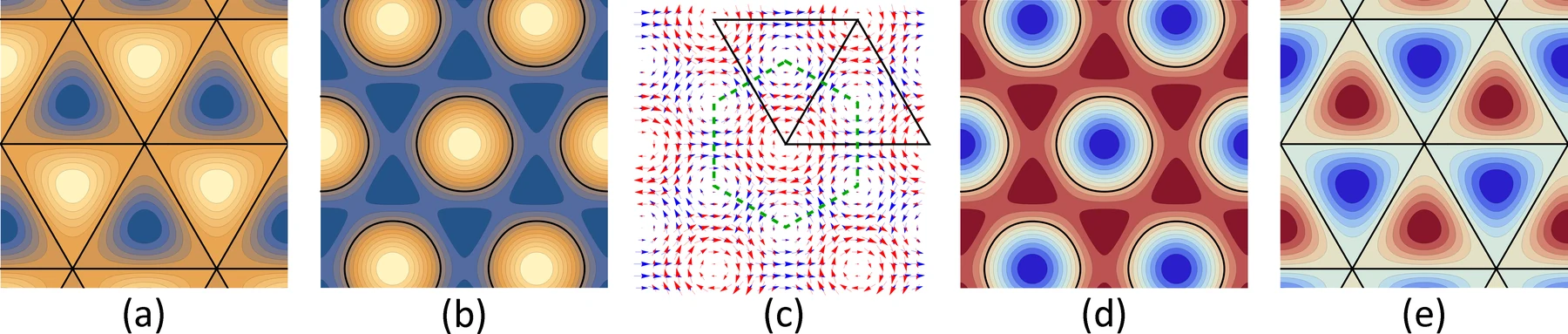
The standard continuum Hamiltonian of a moiré bilayer is a four-component object with an interlayer tunnelling matrix carrying the pattern. One unitary rotation turns it into something else entirely: a single Dirac fermion in two-plus-one dimensions, acted on by two axial-vector fields. One of them is a chiral gauge field; the other is a spin field, measuring spin along the normal to the sheet.
The components of and are built from the AA and AB tunnelling amplitudes and through and . Both are periodic with period , so their field strengths go as . In particular the effective magnetic field is
Eqs. (1)–(6)
A flat band deletes time
Step 3 — the reduction.
This is the hinge. A flat band is a set of states at one energy covering the whole Brillouin zone; going from any of them to any other costs nothing and takes no time, so the transition amplitude between them does not depend on at all. Then time can simply be dropped from the path integral, and a two-plus-one dimensional theory becomes a two-dimensional Euclidean one.
Two-dimensional Euclidean Dirac theory has a chiral anomaly. That is what the assumption of a flat band has bought — and what it will now have to pay for.
Flatness written as an identity on amplitudes:
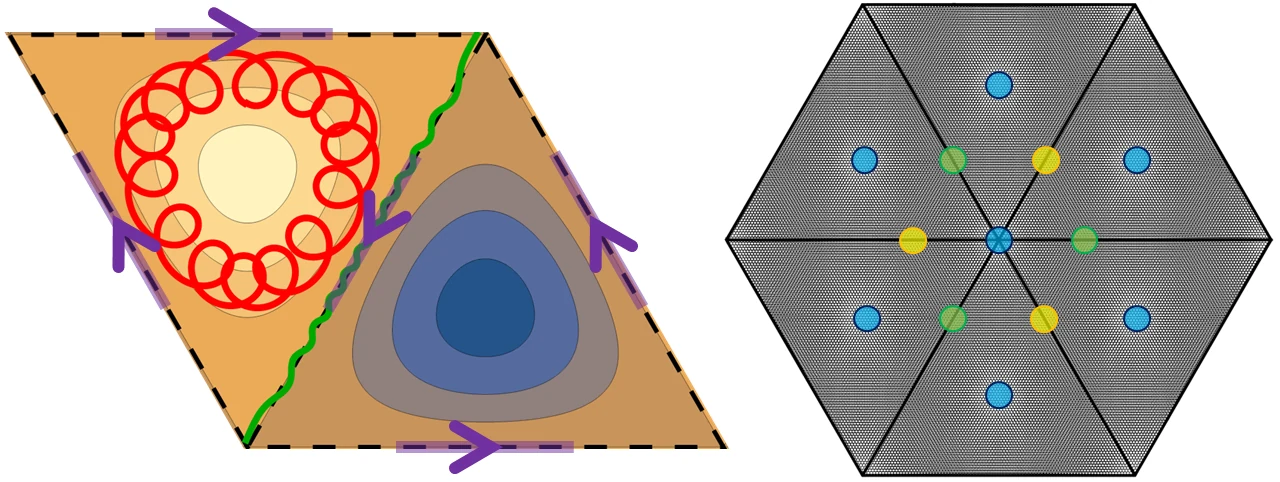
At , where exact flat bands live, the reduced theory is , and the gauge fields being periodic, it factorises over patches sewn along their boundaries. The patches are chosen so that either vanishes on the boundary or is perpendicular to it, which gives the edge configurations an extra chiral symmetry.
Eqs. (8)–(13)
And an anomaly must be an integer
Step 4 — the obstruction.
Rotate the fermion field all the way round. It comes back to itself and the action is unchanged, so the path integral over one patch must be unchanged too. But the measure is not invariant: a chiral rotation multiplies it by a phase, and that phase is the difference between the number of right- and left-handed zero modes.
So the path integral equals itself times a phase. Either the phase is one — the count is a whole number — or the path integral is zero, and the state does not exist.
The phase is the Jacobian of the chiral transformation, tied to the Atiyah–Singer index. If it is not one the only consistent value of is zero — a vanishing partition function, which is to say the state is unrealizable. The spin field earns its keep here by carrying into , which is what lets neighbouring patches be sewn together at all; without it the wavefunctions leak and the band acquires curvature.
Eqs. (14)–(15)
Which is the magic angle
Step 5 — the number.
Evaluate the index for a uniform twist and it is a straight line in the moiré length: double the cell and you double the count. So the condition “whole number” picks out a ladder of lengths, and the first rung is the first magic angle. The Letter puts it at about 1.1°, and gives the series above it a fixed spacing.
With , , and , the Letter gives the first magic angle as . Reading it as a restricted Landau quantisation with , the degeneracy of the moiré Landau level is , so the magic angles come in a series spaced by — in the conventional dimensionless parameter, steps of above a first magic angle at .
Eq. (16)
Then put it in a magnetic field
Step 6 — a prediction.
Because the criterion is a statement about total flux, an external field simply adds to it. But it adds an area rather than a length, so the index stops being a straight line and becomes a parabola — and a parabola can cross the same integer twice. Each magic angle splits in two.
The splitting does not survive an arbitrary field. Above a threshold the two solutions meet and disappear, and the Letter gives that threshold: about 140 mT. Drag the field below and watch it happen.
For the requirement has more than one solution. For small fields, , the positive solutions are
As the first pair returns the old magic angle and the second runs off to infinity — the untwisted bilayer, where the moiré reciprocal lattice is flat and the dispersion is two quadratic bands touching at K.
Eqs. (17)–(19)
What else moves it
The reformulation has uses beyond the criterion. Written as Dirac fermions in two axial fields, the same theory takes external electromagnetic fields, finite temperature, general deformations and interactions without changing shape — which is where Localizing Transitions via Interaction-Induced Flat Bands picks it up, and where Zero-Flux Localization gives the patching argument its exact solutions.